Tuesday, June 28, 2016

God-Given Freedom - Greg Albrecht


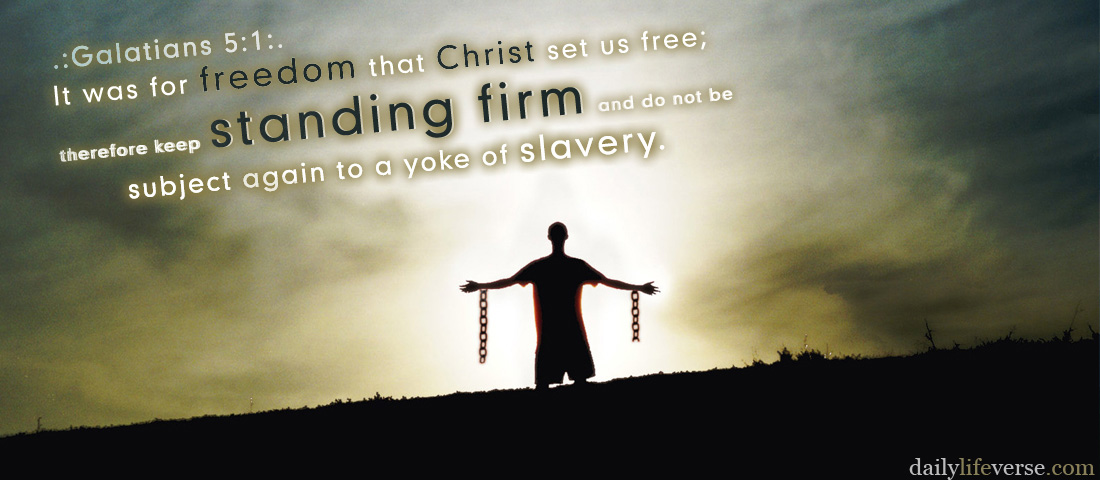
It is for freedom that Christ has set us free. Stand firm, then, and do not let yourselves be burdened again by a yoke of slavery.
  Mark my words! I, Paul, tell you that if you let yourselves be circumcised, Christ will be of no value to you at all. Again I declare to every man who lets himself be circumcised that he is obligated to obey the whole law. You who are trying to be justified by law have been alienated from Christ; you have fallen away from grace. But by faith we eagerly await through the Spirit the righteousness for which we hope. For in Christ Jesus neither circumcision nor uncircumcision has any value. The only thing that counts is faith expressing itself through love.
—Galatians 5:1-6

The history of humanity is a struggle for freedom. The word freedom, and the idea behind it begs for further explanation. Freedom of what? Freedom from what? What kind of freedom? There are many kinds of freedom. 

July 1 is Canada Day, when Canadians celebrate their national freedom as a sovereign nation, and on July 4 the United States does the same. We celebrate that we are free from any foreign power telling us how to live our lives. We celebrate a unique (and it is unique in human history) degree of freedom—guarantees of freedom of speech, freedom of the press, freedom of assembly and freedom of religion. These are truths that we hold to be self-evident. 

But of all the freedoms we can have, freedom in Christ should be the most cherished and most prized because it trumps all other freedoms. One can have political and economic freedom but remain enslaved to false religion. One can live in a free country but still be bound in a spiritual prison. 

I don't consider myself to be a religious person. I used to be, but I am now free in Christ, and I am free from religion. I am a Christian, but I am essentially irreligious. I realize that neither of my grandmothers, if they were alive, would be happy to hear me say this, but at least one of my grandfathers would.

My maternal grandfather escaped from what he called the "old country."

Almost 100 years ago he ran away from the old country of Europe—Germany and the Ukraine—and he didn't want anything to do with what he left behind. He and his family suffered a great deal at the hands of religion, and he wanted none of it when he settled down in a small town in Kansas. He, and many others, sacrificed everything so that they could live in a country that offered freedom FROM religion. 

I learned a similar lesson, but it took me several decades, during which I felt I had discovered the one and only true religion. I was absolutely enslaved to religious legalism and I did my best to convince others that they too needed my unique brand of elitist, narrow, judgmental, hypercritical system of rules and regulations. 

After almost 35 years of bondage my eyes were opened through many life experiences, to see the bankruptcy of any religious system that pretends to impart righteousness through strict observance of rules and regulations. I learned that no priest, no religious prescription nor any religious potion could ever make me good enough to convince God, on the basis of my performance, to love me. I left religion behind over 15 years ago, and I have been, by God's grace, religion-free since that time. 

Tuesday, June 21, 2016

The Return of the Scapegoat (Luke 8:26-39) - Russ Hewett


The story, recorded in Luke 8, of Jesus casting out a Legion of demons from a man is surely one of the most remarkable exorcism stories in history. The man had been living in the tombs, howling and bruising himself, chained and under guard for a long time.  Jesus sent the demons into a herd of some 2000 pigs, which then ran headlong over a cliff to their death in the Sea of Galilee. This is the literal reading of the story.

Humans speak and write in various ways.  We sometimes speak literally, but we often speak or write in a literary way that invites the hearer to seek meaning behind the words of the text.  For instance, if I were building a house and I asked my helper to cut me a 2X4, 48-3/4” long, I wouldn’t expect my helper to ask, “what do you mean by that?”  The request is a literal request and there is no need to seek some deeper meaning in it.  This is how many people approach the Bible.  They expect the Bible to only be speaking literally.  I think however, that the story of the Man of the Gadarenes literally begs to be interpreted in a literary way – like how you might read literature.

This is not to say that the story should not also be understood literally; just that the story might have more to tell us if we approach it as a piece of literature, like how you might approach something written by Shakespeare.


We might begin by looking for symbols – words that held a particular meaning at the time the story was written.  In this story, four words in particular are freighted with meaning – sea, cliff, pigs and stones.

CLICK HERE to continue

No Wrath in God - from T. J. Rynne's "Jesus Christ, Peacemaker"

Editor's Note: The following excerpts come from Terrence J. Rynne, Jesus Christ, Peacemaker: A New Theology of Peace (Mayknoll, NY: Orbis, 2014), 29–31. They reflect an Orthodox theology similar to the 'theology of consent and participation found in Brad Jersak's A More Christlike God.

No wrath in God

Another way of saying there is no violence in God is "there is no wrath of God." The threatening, great God, Jehovah, coming on the cloud of judgment of the wicked is not found in Jesus' reading of the scriptures. The lust for punishment of the bad guys is not God's; it is a human reaction projected onto God. There is judgement, but the judgement of evil is in the evil itself playing itself out to its own demise. Humans who refuse the offer of goodness judge themselves by the measure with which they judge others. That leads to complete self-aborption and can descend into what can only be called hell. ...

Forgiveness doubled

"God is always in himself the kind father who meets sinners with anticipatory love; only if sinners, despite the experience of grace, cling to their own criteria of judgement do te imprison themselves," Schwager writes. Even the murder of his own son did not provoke the reaction of vengeful retribution. The risen Jesus appeared with the message of peace and forgiveness--even to those who had reject the offer the first time. Forgiveness doubled. In the events after the resurrection we clearly see the nonviolent face of God....

God's response to human obduracy is to deliver humankind to ourselves. We do make our own beds and lie in them. We do indeed make our own hells. God does not break in to punish us; we do it to ourselves. God's so-called wrath consists in granting full respect for our freedom. The possibility exists that humans could resist even redemptive and unfathomably forgiving love.

Only unfathomable love

Jesus' concern was focused on the here and now, the events of history and where those events lead. He used language that is "apocalyptic," that is, taking historical and political events metaphorically to demonstrate the built-in trajectory of those events into the future. As James D. G. Dunn describes it: "Apocalyptic language has to be understood metaphorically in reference to historical and political events rather than literally in reference to the end of the world. ... Neither Jesus nor his contemporaries were expecting the end of the space-time universe."

No wrath in God. No violence. Only unfathomable love. With that understanding of the God of his forefathers, Jesus could not countenance a political order built on exclusion, separation, and hatred of the enemy--in the name of religion, in the name of their God. If there is no violence in God, that undercuts the age-old tendency of humans to label those who are outside the privilege circle as threats, as enemies, as evil--to dehumanize them and then make them objects of righteous, sacralized violence.

Monday, June 20, 2016

CWR Video: Richard Rohr Interview pt 2 - What do we mean by "dualistic thinking"?

02 Richard Rohr - What do we mean by "dualistic thinking"? from Plain Truth Ministries on Vimeo.

The Gathering Storm of Fundamentalism - Greg Albrecht


It is one of the most explosive issues facing our world in the early years of this 21st century. Political and religious agendas around the world are bullied and coerced, reacting to a virus-like spiritual plague of religious fundamentalism. The Islamic fundamentalist reaction to Western imperialism and decadence is said to be a counter-attack on the "great Satans" of our culture (materialism, immorality, secularism, humanism, science and technology), all of which are blamed for taking our world to hell in a hand-basket.
Though the eyes of the world are currently focused on Islamic fundamentalism, the seeds of radical religious fundamentalism are found in virtually all of the world's major religions. 

Fundamentalism, whatever its outward attire might be, is convinced that society wants to wipe out its faith and practice. Fundamentalists tend to see the world as "them" and "us"—they feel trapped, with their backs against the wall, and obligated to fight for their faith under their fundamentalist flag. 

Extreme Islamic beliefs and practices are, without a question, a dangerous, turbulent storm of fundamentalism that overshadows our entire western world. But while it lurks in the shadows, extreme fundamentalism in the name of Jesus also portends a clear and present spiritual danger. Fundamentalism is fostering dramatic changes, forcing us to rethink our moral priorities, whether we like it or not.

When Calls for Peace Are Dismissed
Hate-filled rhetoric and passionate appeals for bloodshed in the name of God are the manipulative interpretations of teachers who are war-mongers thirsting for blood, yearning for revenge and violence. Terrorists who torture and maim, fueled by anger and lust (James 4:1-3) hide like cowards behind the skirts of God (or Allah), desperately trying to remake divinity into their own violent image.

CLICK HERE to continue

Saturday, June 18, 2016

On Fearing God - Rob Grayson


Today I’d like to talk a little bit about God and fear. Specifically, about how the two are often deeply intertwined in our thinking.

It seems to me that fear is closely associated with our default understanding of God. Indeed, we might even say that for many people, fear is the instinctive emotional response to thoughts of God. Long-established expressions like “to put the fear of God into someone” illustrate just how intimately the emotion of fear is connected with the idea of God.

And, of course, those wishing to draw on the Bible to support the notion that fear is an appropriate response to God can do so with ease. “The fear of the Lord is the beginning of wisdom”, we are told in Proverbs 9:10. And there’s no shortage of accounts throughout the text of scripture where God or his angels appear to strike fear into people’s hearts.

So, fear is typically quite ingrained in our psyche as a response to God, and many assume that the Bible validates its appropriateness.


And yet…

The writer of the first epistle of John, shortly after telling us that God is love, has this to say:

“There is no fear in love, but perfect love casts out fear; for fear has to do with punishment, and whoever fears has not reached perfection in love.” (1 John 4:18)

And so we have a seeming paradox: on the one hand, fear of God is something appropriate and even valuable and necessary; but on the other hand, God is love, and as such, there is no place or reason for fear in him.

CLICK HERE to continue

Friday, June 17, 2016

Experiencing Brokenness - Rob Grayson


We often think of brokenness as a place we come to either when we’re faced with the consequences of our own actions or when the actions of others, or events beyond our control, leave us wounded and in pain. This is, I think, an entirely valid and appropriate use of the word “brokenness”: sometimes we are broken by the disastrous consequences of our own poor choices, by the actions of other people, or by a host of other seemingly random causes collectively known as “life”.

However, there is also another sense of the word “brokenness”, and it is simply this: that we are all wounded, and so we are all broken in various ways.

Some of the wounds we carry we are well aware of, maybe because we sustained them in some terrible experience that we will never forget, or perhaps simply because the pain of them is so great that it continues to dominate our world. Other wounds are buried under many layers of self-protective armour. Either way, and however well we might appear to mask it, there is brokenness in all of us, deep down.


All of us are or have been broken in some way. The only difference is that some of us know it and others don’t.

Often, it takes an experience of the first kind of brokenness to bring us to a place where we can acknowledge the second kind. In other words, it often takes an intensely painful crisis to bring us to a place where we become aware of – or are prepared to recognise – the underlying low-level brokenness we’ve been carrying around like heavy baggage for years. For me, it took the painful and humiliating admission that I had developed a drink problem to drag me to a place where I was open enough, and my defences were lowered far enough, for me to begin to be able to see and name the wounds I’d been nursing, some of them since childhood.

This brings us to two more things I think we can say about brokenness.